Authentication
Issue a scoped API key, send it on either supported header, manage its lifecycle, and understand the layered gate behind the 403 most first calls hit.
Every v1 request is authenticated with a workspace API key. There are no user tokens and no OAuth: a key is scoped to one workspace and acts only on that workspace's data.
Issue a key
In the dashboard, open Settings → API keys and create one (workspace owner or admin only). Give it a name to track where it is used, and pick its scopes — the subset of the API it may call.
The key is shown once, at creation. Only a SHA-256 hash and a short prefix are stored, so it cannot be retrieved later — copy it into your secret store immediately. Lost a key? Revoke it and issue a new one.
Keys look like this:
blm_<random token>A key's scopes are fixed at creation and immutable — to change scopes, revoke the key and issue a new one with the right set. See Scopes for the registry.
Issuing a key is recorded in your audit log, with the public prefix only — never the key itself.
Send it
Two headers are accepted; use either.
curl https://app.evoriqa.com/api/v1/chatbots \
  -H "Authorization: Bearer $EVORIQA_API_KEY"

# or
curl https://app.evoriqa.com/api/v1/chatbots \
-H "x-api-key: $EVORIQA_API_KEY"const res = await fetch("https://app.evoriqa.com/api/v1/chatbots", {
headers: { Authorization: `Bearer ${process.env.EVORIQA_API_KEY}` },
});
const { data } = await res.json();
console.log(data.data);import os, requests
res = requests.get(
"https://app.evoriqa.com/api/v1/chatbots",
headers={"Authorization": f"Bearer {os.environ['EVORIQA_API_KEY']}"},
timeout=30,
)
print(res.json()["data"]["data"])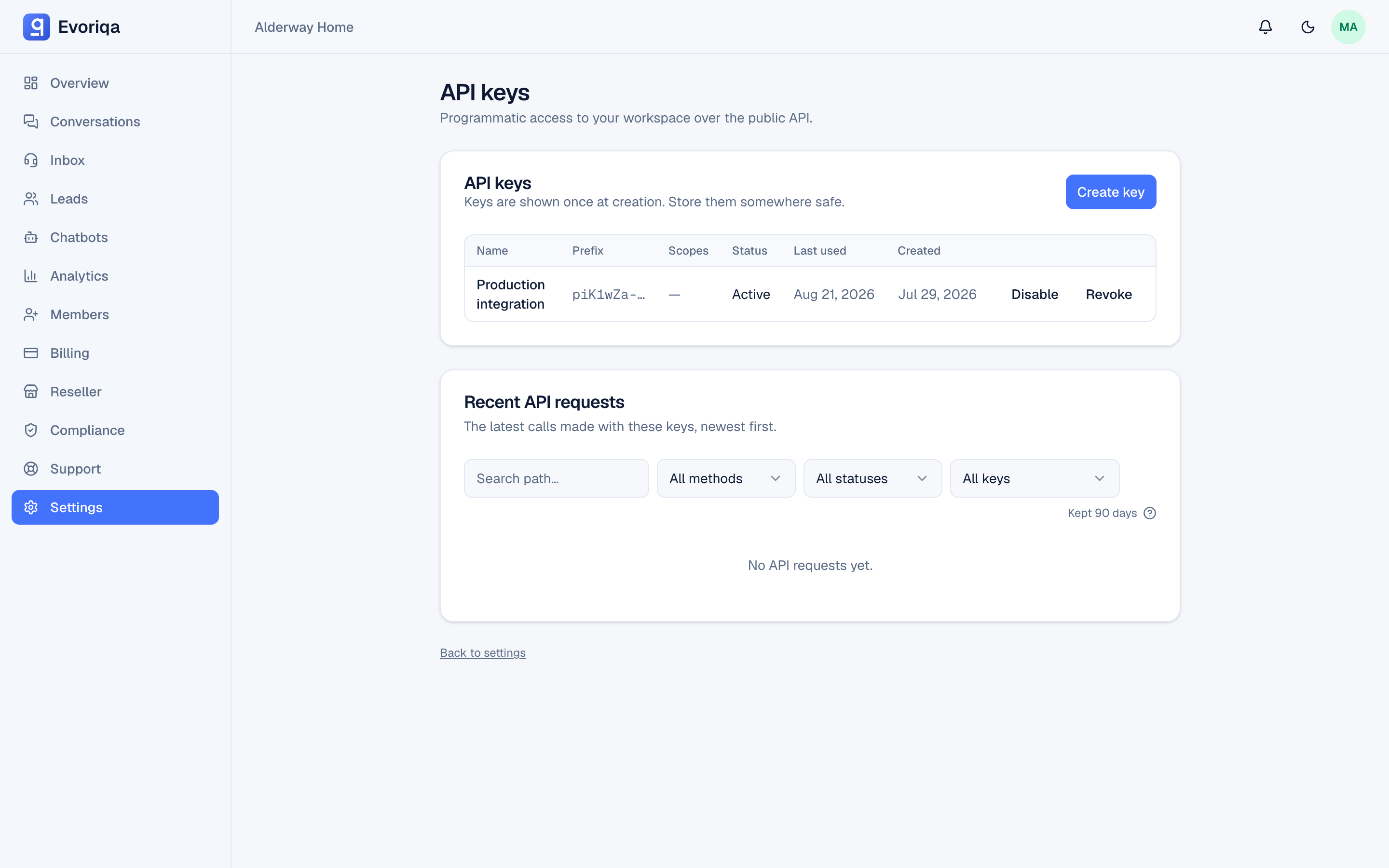
Never hard-code a key, commit one, or ship one to a browser. The API is server-to-server only — it sends no CORS headers — and a key can now write: reply to customers, delete chatbots, change settings. Every sample here reads it from an environment variable — do the same.
The 401s
A request with no key at all:
{
  "success": false,
  "error": { "code": "UNAUTHORIZED", "message": "Missing API key." }
}A key that does not exist, is malformed, or has been revoked is also 401, with "Invalid API key.". A key you have disabled is 401 with "API key is disabled." — a distinct message, because it is your own reversible state, not a platform action.
API access has to be enabled for your workspace
A valid key is not enough: the API is off until it is enabled for your workspace. Until then every request — and every attempt to issue a key — returns:
{
  "success": false,
  "error": {
    "code": "FORBIDDEN",
    "message": "API access is not enabled for this workspace."
  }
}This is the most common reason a first call fails, and retrying will not change it. What to do depends on who you buy from:
- Direct customers — check that your plan includes API access, then contact Evoriqa support to have it enabled.
- Clients of an agency or reseller — your provider controls it. Ask them; see Per-client API access.
The message is deliberately the same whatever the underlying reason, so treat it as one condition: "not enabled yet".
Enabling takes effect immediately on keys that already exist — access is checked live on every request, so you do not need to reissue anything once it is switched on.
Key lifecycle: disable, revoke, rotate
Settings → API keys manages the whole lifecycle:
- Disable — a reversible pause. The key rejects requests with
API key is disabled.until you re-enable it. Use it to stop an integration without destroying its key. - Revoke — permanent. Revocation is immediate; the next request with that key is
401 Invalid API key., forever. Revoking an unknown or already-revoked key returns404rather than reporting a false success. - Rotate — issue the new key, deploy it, then revoke the old one. There is no in-place rotation, because scopes and the secret are fixed at creation.
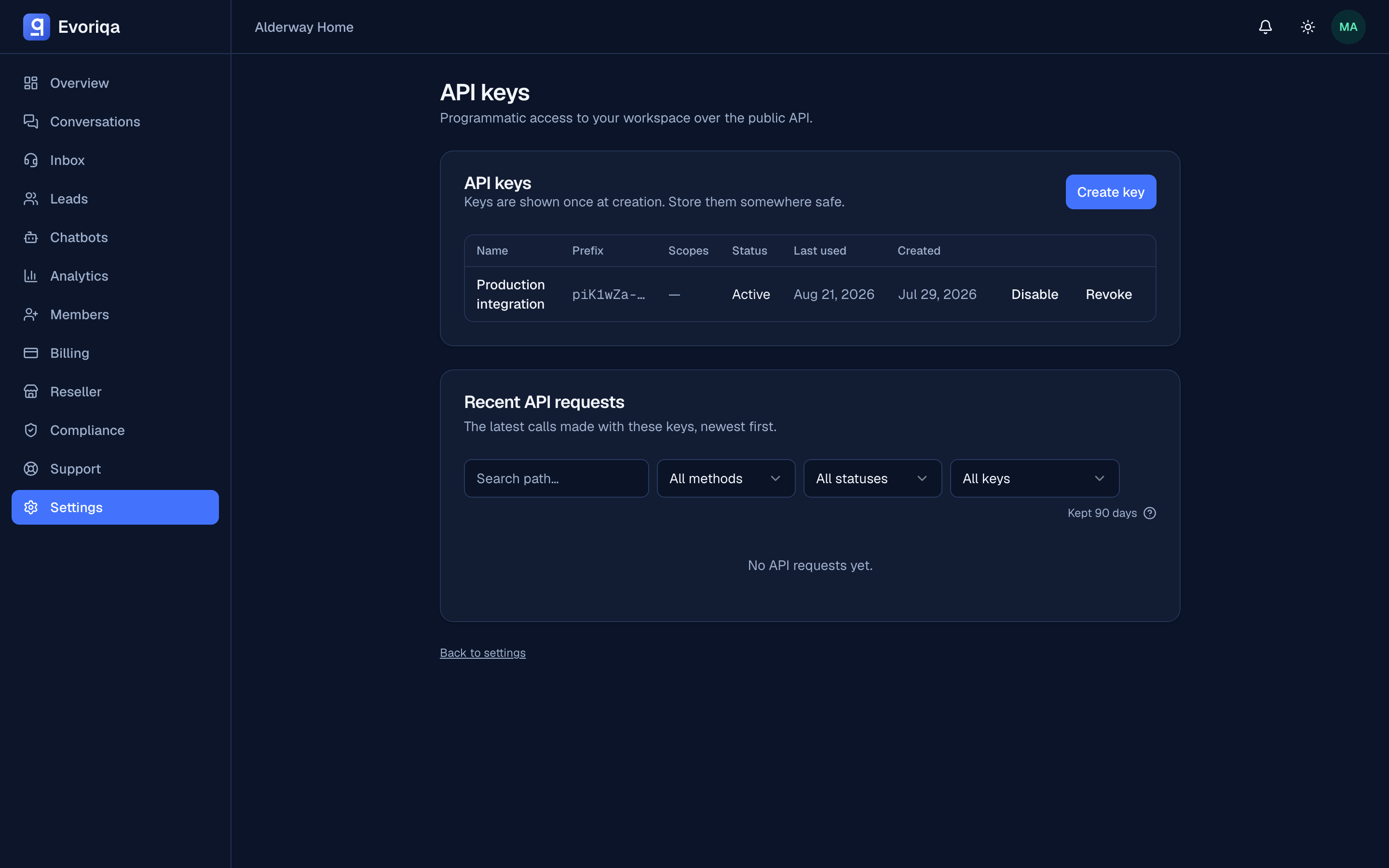
The same page shows each key's request log — every v1 call made with it, including the ones that fail auth or hit a limit (401, 403, 429). Each row records the method, path, status, latency, and a SHA-256 hash of the caller IP (never the raw address). Rows are kept for up to 90 days — and sooner if your workspace's data-retention window is shorter. Use it to confirm what an integration actually did before revoking its key.
Where to go next
Last updated