Credits and top-ups
What a credit is, what consumes credits, the burn alerts at 50/80/100%, how one-time top-up packs work, and what happens when you run out.
A credit is the unit of AI usage, mapped to real provider cost. Paid plans grant a monthly credit allowance; usage draws it down. Plan credit is use-it-or-lose-it — the month's unspent allowance does not roll into the next month.
What consumes credits
- Answering a visitor's question — including retrieval, re-ranking, and classification, not only the final reply.
- Voice calls, which debit a per-minute rate on top of the per-turn cost, billed in six-second increments when the call ends. See Voice.
- Actions the agent runs.
- Copilot drafts and summaries.
- Embedding your knowledge sources when they are processed.
Human replies in the inbox cost nothing.
The ledger
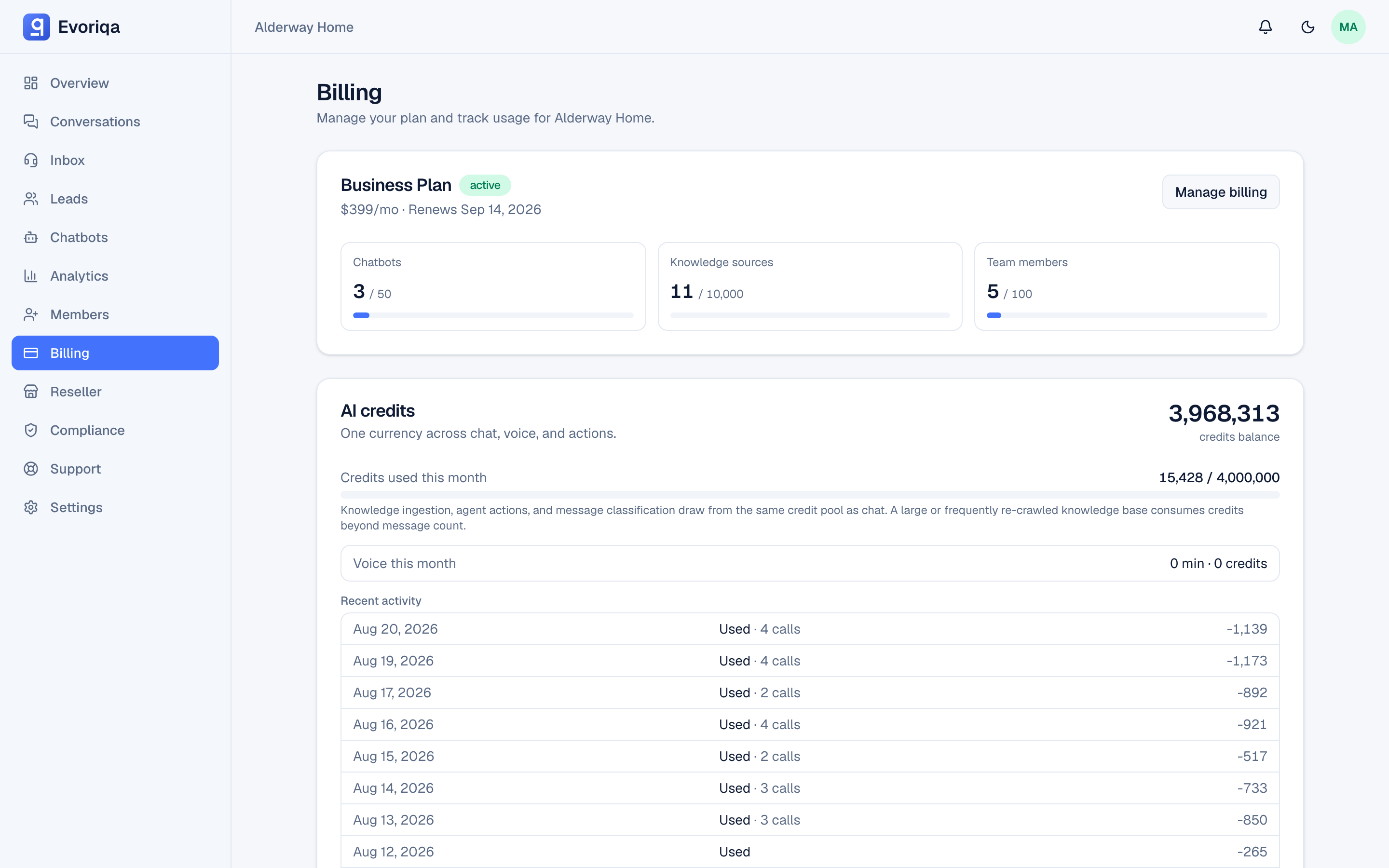
The billing page shows your balance, live usage bars, and a recent ledger of grants and debits. At each renewal the ledger carries an Expired unused credits row — the previous month's leftover plan credit forfeited just before the new month is granted. Credit figures on Analytics count a wider population than the billing ledger — see Analytics overview for why the two differ.
Burn alerts
The workspace owner is emailed at 50%, 80%, and 100% of the cycle's credit allowance — once per threshold per cycle. Adding a top-up re-arms the ladder, so you are warned again on the new balance rather than going quiet. A renewal resets the cycle too, so the ladder starts fresh against the new month's allowance.
Top-up packs
One-time credit packs are bought self-serve from the billing page; Stripe Checkout opens in a new tab, and the billing page refreshes when you come back. What to know:
- They never expire.
- They need no plan change — a busy month does not have to become a bigger subscription.
- They are the only credit that survives a renewal. When a renewal forfeits the previous month's unspent plan credit, your purchased packs are left untouched (and an in-flight AI turn's reserved credit is held back from the forfeit too).
- They may be limited per month. The platform can cap how many packs an account buys per calendar month (UTC). When a limit applies, the billing page shows how many are left this month; at zero the packs are disabled until the 1st, and a checkout attempt is refused with the reset date.
Reselling? Your organisation buys packs straight into its shared pool instead of onto one workspace — see Pooled credits and caps.
Running out
Exhaustion is handled gracefully rather than as an error:
- Visitors get a friendly "assistant is unavailable" reply, not a billing message.
- The voice agent says the equivalent.
- The owner sees a clear "you're out — top up or upgrade" banner.
- Human handoff keeps working, so your team can still answer.
Programmatically, a request refused for exhausted budget is USAGE_LIMIT_REACHED with HTTP 402.
Where to go next
- Cost caps — capping spend before you run out.
- Pooled credits and caps — the reseller model.
Last updated